Personal Loan for Bad Credit Score in India: The Reserve Bank of India kept the repo rate unchanged at 5.25 percent after its August 2026 Monetary Policy Committee meeting, the fourth pause in a row under Governor Sanjay Malhotra. For most borrowers that sounds like routine news. But for anyone trying to get a personal loan for bad credit score in India, the real story sits one layer below the headline. Since January 1, 2026, RBI’s revised digital lending directions have forced every bank, NBFC and lending app to disclose the full cost of a loan upfront, report your repayment behaviour to credit bureaus roughly every fifteen days, and stop routing money through middlemen accounts. That single change has quietly reshaped who gets approved, at what rate, and how fast a slipped EMI now shows up on your CIBIL report.
If your credit score has taken a hit and a bank recently turned down your loan application, you are not out of options. NBFCs, fintech lenders and a few structured alternatives are actively approving low CIBIL score borrowers this year, just on different terms than a traditional bank would offer. This guide breaks down current eligibility, interest rates, top lenders, the application process and the fastest realistic ways to improve your approval odds. We’ll be updating this article monthly as RBI policy, interest rates and lender criteria change.
What Counts as a Bad Credit Score in India Right Now
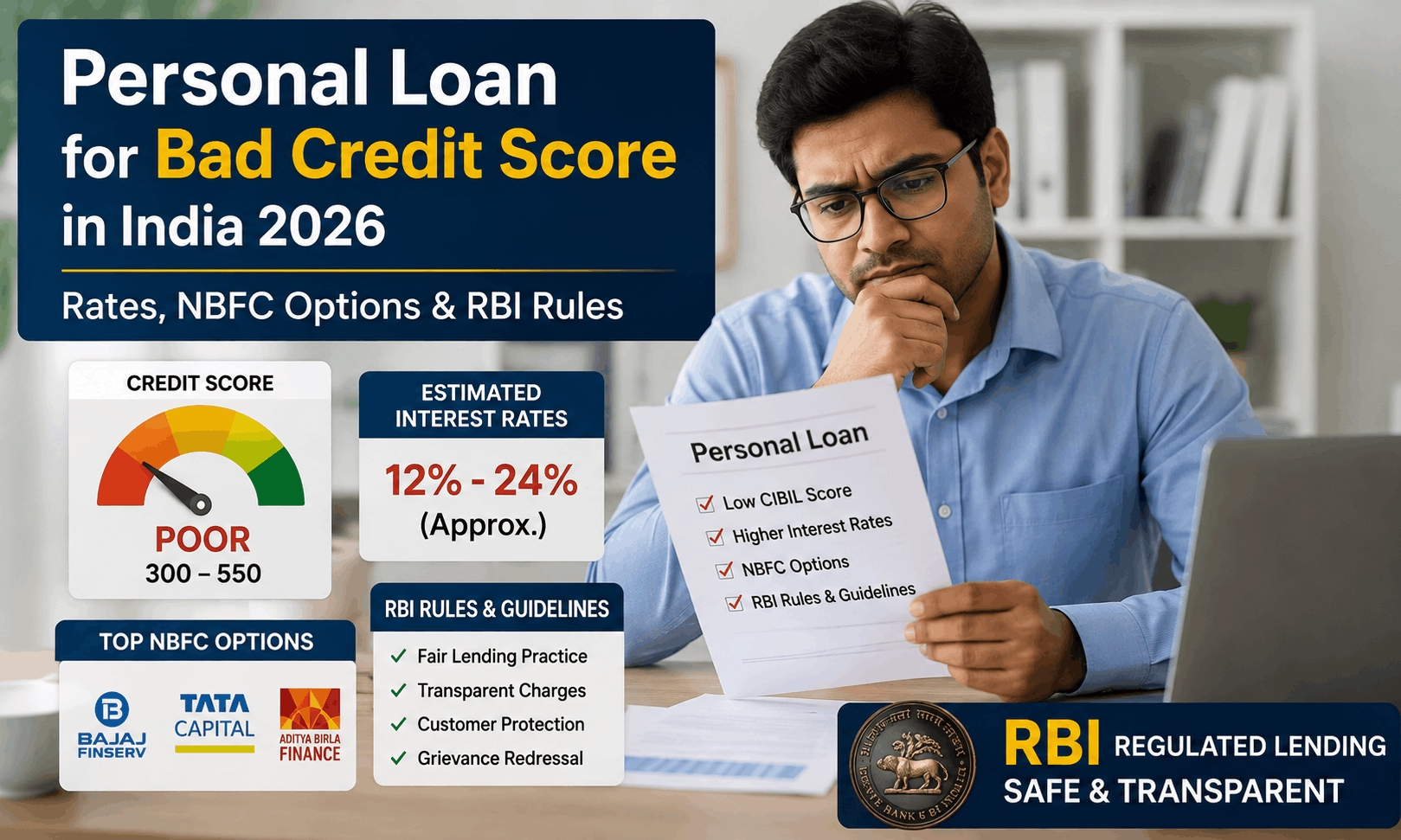
Credit bureaus in India, including CIBIL, Experian and Equifax, score borrowers on a scale of 300 to 900. A score above 750 is considered healthy and usually gets you the best personal loan interest rates from banks. Anything between 650 and 749 is workable but comes with tighter scrutiny. Below 650 is where most private and public sector banks start rejecting applications outright, and a score under 600 is generally treated as high risk across the industry.
That said, lenders read the number differently depending on why it dropped. A score that fell because of two or three missed EMIs during a rough patch, with income now stable again, is viewed very differently from a score that is low because existing debt already consumes most of the borrower’s monthly salary. The first case is genuinely financeable. The second usually needs debt restructuring before taking on a new loan.
How RBI’s 2026 Lending Rules Affect Low CIBIL Applicants
The RBI Digital Lending Directions, issued in May 2025 and effective from January 2026, introduced several changes that directly affect anyone applying for a personal loan for bad credit score in India:
Mandatory Key Fact Statement: Every regulated lender must now show the full Annual Percentage Rate, including interest and every fee, in a single standardised document before you accept the loan. This makes it far easier to compare the true cost between an NBFC charging 24 percent and one charging 30 percent once processing fees are added in.
Direct disbursal only: Loan amounts must be transferred straight from the lender to the borrower’s bank account. No lending service provider or agent is allowed to hold the money in between, which closes a major fraud loophole that low credit score borrowers were especially exposed to.
Faster credit bureau reporting: Repayment data now reaches CIBIL and other bureaus roughly every fortnight instead of monthly or quarterly. This cuts both ways. A missed payment shows up faster, but so does a recovery. Borrowers who stay disciplined for three to four months can now see a visible score improvement sooner than under the old reporting cycle.
Zero prepayment penalty on floating rate loans: If you take a personal loan for bad credit score in India after January 1, 2026, you can close it early without an extra charge, which matters for high interest borrowers looking to pay down debt as soon as their finances stabilise.
Public directory of approved apps: Only lending apps registered with RBI’s Centralised Information Management System and listed by their partner bank or NBFC are authorised. Anything outside that list is operating without RBI oversight.
Interest Rates for Bad Credit Personal Loans in 2026
Interest rates for a personal loan with a weak credit history vary sharply depending on whether you approach a bank or an NBFC. A borrower with a score above 750 can typically access rates between 10 and 16 percent per annum from a bank. A borrower around the 600 to 650 mark, applying through an NBFC or digital lender, should expect rates in the 18 to 36 percent range, along with a processing fee of roughly 1 to 3 percent of the loan amount.
| Credit Score Range | Typical Lender Type | Approximate Interest Rate | Typical Loan Amount |
|---|---|---|---|
| 750 and above | Banks | 10% to 16% p.a. | Up to Rs 40 lakh |
| 700 to 749 | Banks and larger NBFCs | 14% to 20% p.a. | Up to Rs 15 lakh |
| 650 to 699 | NBFCs and fintech lenders | 18% to 28% p.a. | Rs 50,000 to Rs 5 lakh |
| 600 to 649 | NBFCs, digital lenders | 22% to 32% p.a. | Rs 15,000 to Rs 3 lakh |
| Below 600 | Select NBFCs, secured or co-applicant loans | 28% to 36% p.a. | Rs 10,000 to Rs 1 lakh |
These figures are indicative and change with each lender’s internal risk policy, so always check the Key Fact Statement before signing.
Personal Loan Up To 50 Lakh India: How to Compare Rates, Eligibility, and Documents in 2026
Lenders That Consider Low CIBIL Score Applicants
Several NBFCs and bank-backed digital lenders have built underwriting models that weigh income stability and bank statement patterns alongside the credit score rather than rejecting an applicant on score alone. Names commonly seen approving low CIBIL score borrowers in the current market include Bajaj Finserv, Tata Capital, Mahindra Finance, Fibe, MoneyView, KreditBee and IIFL Finance, among others. Each of these operates as a Regulated Entity or works with one, meaning they fall under RBI’s fair practices code.
Before applying anywhere, confirm that the lender or app appears on the RBI or the partner bank’s official list of authorised digital lending apps. A large share of loan fraud complaints in India still trace back to apps that were never registered with RBI in the first place.
Eligibility Criteria for a Bad Credit Personal Loan
Requirements differ by lender, but most NBFCs offering a personal loan for bad credit score in India apply a similar baseline:
Age between 21 and 58 years at the time of application. Minimum monthly income that varies by city and lender, commonly starting around Rs 15,000 to Rs 25,000 for salaried applicants. Stable employment history, typically at least six months with the current employer or a consistent income pattern for self-employed applicants. An active bank account with visible salary or business credits over the past three to six months. A CIBIL or Experian score that many NBFCs will still evaluate from 600 upward, and in some cases lower if income signals are strong.
Documents You Will Need
Most lenders ask for a similar document set regardless of credit score: PAN card, Aadhaar card or another government photo ID, the last three to six months of bank statements, recent salary slips or income tax returns for self-employed applicants, and a passport size photograph. Digital lenders often complete this entire process through an app using e-KYC, which speeds up approval to within a few hours for smaller loan amounts.
How to Apply?
Start by checking your credit report directly on the CIBIL or Experian website so you know your actual score rather than relying on an estimate. Compare at least three to four lenders using their Key Fact Statement rather than the advertised headline rate, since processing fees and insurance add-ons can change the real cost significantly. Apply to only one or two lenders at a time, because every hard enquiry temporarily dents your score further. Read the loan agreement fully before accepting, paying close attention to prepayment terms, late payment charges and whether the interest is flat or reducing balance. Once approved, set up an auto-debit mandate for the EMI so a payment is never missed due to oversight.
Realistic Ways to Improve Your Approval Odds
A credit score does not fix itself overnight, but a few actions genuinely move the needle within a few months under the new fortnightly reporting cycle. Clearing any overdue credit card balance first has an outsized effect, since revolving debt utilisation weighs heavily on the score. Adding a co-applicant with a stronger credit history can shift both the approval decision and the interest rate offered. Applying for a smaller loan amount than the maximum you qualify for also improves approval odds, since lenders view a conservative request as lower risk. Some borrowers use a secured route instead, such as a loan against a fixed deposit or gold, which does not depend on the credit score at all and typically carries a much lower rate.
Key Highlights
| Detail | Current Status |
|---|---|
| RBI Repo Rate | 5.25% (August 2026 MPC, unchanged) |
| RBI Digital Lending Directions | Effective January 1, 2026 |
| Credit Bureau Reporting Frequency | Roughly every 15 days |
| Prepayment Penalty on Floating Rate Loans | Nil, after January 1, 2026 |
| Typical Bad Credit NBFC Interest Rate | 18% to 36% per annum |
| Minimum Score Considered by Most NBFCs | Around 600, some go lower |
| Next RBI MPC Meeting | October 5 to 7, 2026 |
Official Resources and Links
| Purpose | Official Website |
|---|---|
| RBI official website and circulars | https://www.rbi.org.in |
| Check registered and unauthorised lending apps | https://sachet.rbi.org.in |
| RBI complaint and grievance portal | https://cms.rbi.org.in |
| Free CIBIL score check | https://www.cibil.com |
| Experian credit report India | https://www.experian.in |
| National Consumer Helpline | https://consumerhelpline.gov.in |
FAQs
Can I get a personal loan with a CIBIL score below 600 in India?
Yes, though options narrow significantly. A handful of NBFCs and digital lenders still consider applicants below 600 if income is stable, but expect a smaller loan amount, a higher interest rate, and possibly a request for a co-applicant or collateral.
Which banks give loans for bad credit score in India?
Most traditional banks are conservative below a 650 to 700 score. Borrowers in this range usually have better luck with NBFCs such as Bajaj Finserv, Tata Capital or Mahindra Finance, or with digital lenders partnered with a regulated bank.
Does applying to multiple lenders hurt my credit score?
Yes. Every loan application triggers a hard enquiry on your credit report, and several enquiries within a short window can lower your score further. It is better to compare offers online first and apply to only one or two lenders.
How fast does RBI’s new reporting rule update my score after I repay?
Under the current fortnightly reporting cycle, timely EMI payments typically reflect in your credit report within two to four weeks, faster than the older monthly or quarterly cycle.
Is it safe to take a loan from an app that is not listed with RBI?
No. Apps outside RBI’s authorised list are not bound by the Digital Lending Directions, which means there is no guarantee on data protection, fair recovery practices, or transparent pricing. Always verify the app or its partner NBFC before sharing any documents.
Can a gold loan work as an alternative to a personal loan for bad credit score in India?
Yes. A gold loan does not require a minimum credit score since it is secured against the gold itself, and rates are generally lower than an unsecured bad credit personal loan.
Conclusion
A weak credit score no longer closes every door in India’s lending market, but it does change the path you need to take. RBI’s 2026 lending rules have made the true cost of borrowing far more transparent and have shortened the time it takes for good repayment behaviour to actually improve your score. For now, the realistic route for most low CIBIL score borrowers runs through NBFCs and RBI-registered digital lenders rather than traditional banks, with a clear focus on comparing the Key Fact Statement, borrowing conservatively, and rebuilding the score before applying for a larger loan later. Always confirm any lender’s RBI registration before sharing documents or paying an upfront fee.