Personal Loan Eligibility in India: Banks and NBFCs in India are still holding a 125 percent risk weight on every unsecured personal loan they issue, a rule the Reserve Bank of India first brought in back in November 2023 and has kept in place through 2026 to slow down runaway growth in consumer credit. That single number sits behind almost every rejection letter this year. It forces lenders to set aside more capital for each personal loan sanctioned, which means underwriting teams now look far more closely at personal loan eligibility in india before approving anything, instead of leaning mainly on a good credit score the way they did a few years ago.
Layered on top of that is RBI’s Digital Lending Directions, effective since January 1, 2026, which require every regulated lender to hand applicants a standardised Key Fact Statement showing the full cost of the loan before they accept it. Between tighter capital rules on one side and mandatory transparency on the other, the eligibility bar for a personal loan has genuinely moved, and a lot of the eligibility advice floating online is now outdated. This guide walks through exactly what lenders check in 2026, the documents you will be asked for, and the specific factors that decide whether your application gets approved or quietly rejected. We’ll be updating this article monthly as lending norms and interest rates change.
What Personal Loan Eligibility Actually Means
Eligibility is not a single yes or no gate, it is a composite score a lender builds from several inputs at once. Age, income, employment type, existing debt, credit history and even the company you work for all feed into an internal risk model. Two applicants earning the same salary can get very different offers, or one approval and one rejection, because the underlying risk profile looks different once all these factors are combined. Understanding each factor individually is the fastest way to know where you stand before you apply, rather than finding out after a hard enquiry has already dented your credit report.
Age and Employment Requirements in 2026
Most lenders in India require salaried applicants to be between 21 and 60 years old at loan maturity, while self-employed applicants are typically allowed up to 65 years since business income is assessed differently from a fixed salary. Employment stability matters as much as the number itself. Lenders generally want to see at least one to two years of continuous employment or business operation, with private and public sector salaried employees viewed more favourably than those with frequent job changes. Employees at listed companies, government departments or established MNCs often get faster approvals and marginally better rates than those at very small or newly formed private firms, since the lender treats employer category as an informal risk signal.
Income Thresholds That Decide Approval
Minimum income requirements vary by city tier and by lender. Metro city applicants are typically expected to show a net monthly income of Rs 25,000 or above, while applicants in smaller towns can often qualify starting around Rs 15,000, though the eligible loan amount scales down accordingly. Self-employed applicants are judged on average annual profit from Income Tax Returns over the last one to two years rather than a single month’s income, which is why a seasonal business owner may need to submit a longer income history to prove stability.
Best Student Loan Apps in India in 2026: What the Latest Government Data Shows Before You Apply
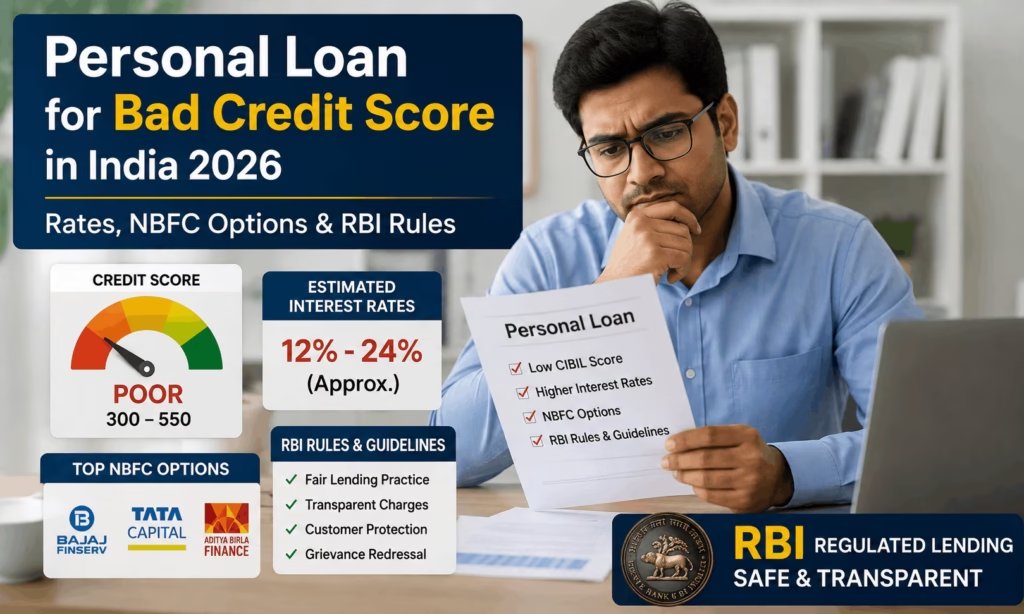
Get A Personal Loan For Bad Credit Score In India In 2026, With Rates, NBFC Options And RBI Rules
Credit Score and Credit History
A CIBIL or Experian score of 700 or above is generally treated as acceptable across most banks and NBFCs, with scores of 750 and higher unlocking the lowest interest rates and highest loan amounts. Scores between 650 and 699 usually still get approved but at a higher rate, mostly through NBFCs rather than large banks. Below 650, approval becomes lender specific and often depends more heavily on income stability than the score itself. Beyond the number, lenders also read the credit report itself, checking for late payments in the last twelve months, how many loans you have open at once, and how much of your available credit card limit you are actually using, since high utilisation is read as a stress signal even when the score itself looks reasonable.
Debt to Income Ratio and Existing Obligations
Debt to income ratio, meaning the share of your monthly income already going toward EMIs and credit card minimum dues, has become one of the most closely watched numbers under the current risk weight environment. Most lenders prefer this ratio to stay under 40 to 50 percent including the new loan’s proposed EMI. An applicant with a strong income but three running EMIs and a high credit card balance can still get rejected or offered a much smaller amount than expected, because the incremental risk of one more monthly obligation outweighs the income on paper.
Documents Required for Salaried Applicants
Salaried applicants typically need to submit a PAN card, Aadhaar card, the last three months of salary slips, bank statements showing salary credits for the last three to six months, and a recent passport size photograph. Some lenders also ask for Form 16 or the latest income tax return as a secondary income proof, particularly for higher loan amounts.
Documents Required for Self-Employed Applicants
Self-employed individuals and business owners generally need to provide PAN and Aadhaar, Income Tax Returns for the last one to two years, bank statements for the last six months covering both personal and business accounts, and proof of business continuity such as GST registration, a shop establishment certificate, or a partnership deed depending on the business structure. Because self-employed income can fluctuate, lenders often average it across a longer period rather than relying on the most recent year alone.
How the Loan Amount Is Actually Calculated
Lenders typically use an EMI to income ratio to decide the maximum amount they will sanction, commonly capping total EMI obligations, including the new loan, at around 50 to 60 percent of net monthly income. A rough industry approach multiplies net monthly salary by a factor tied to tenure and interest rate to arrive at an eligible amount, though the exact multiplier differs by lender and risk appetite. Most bank and NBFC websites now offer an online eligibility calculator where entering income, existing EMIs and desired tenure gives an instant estimate before a hard credit enquiry is triggered, which is worth using before formally applying anywhere.
Common Reasons Personal Loan Applications Get Rejected
The most frequent rejection reasons in the current lending environment include a credit score below the lender’s internal cutoff, a debt to income ratio that is too high once the new EMI is added, income that falls short of the lender’s city-specific minimum, frequent job switching within the past year, multiple loan applications submitted within a short window causing several hard enquiries, and incomplete or mismatched documentation such as an address on the application that does not match the Aadhaar record.
Ways to Improve Your Eligibility Before Applying
Paying down existing credit card balances before applying has one of the biggest immediate effects on eligibility, since it directly lowers both credit utilisation and the debt to income ratio. Avoiding multiple loan or credit card applications in the weeks before you apply protects your score from unnecessary hard enquiry damage. Adding a co-applicant with stable income can improve both the sanctioned amount and the interest rate offered. Choosing a slightly longer tenure lowers the monthly EMI and can push a borderline application over a lender’s eligibility threshold, though it does increase the total interest paid over the life of the loan.
Key Highlights
| Detail | Current Status |
|---|---|
| RBI risk weight on unsecured personal loans | 125%, unchanged through 2026 |
| RBI Digital Lending Directions | Effective January 1, 2026 |
| Minimum credit score generally accepted | 700, with 750+ preferred |
| Typical minimum income, metro cities | Rs 25,000 per month |
| Typical minimum income, smaller cities | Rs 15,000 per month |
| Preferred debt to income ratio | Under 40% to 50% including new EMI |
| RBI repo rate | 5.25% (August 2026 MPC, unchanged) |
Official Resources and Links
| Purpose | Official Website |
|---|---|
| RBI official website and circulars | https://www.rbi.org.in |
| Check registered and unauthorised lending apps | https://sachet.rbi.org.in |
| RBI complaint and grievance portal | https://cms.rbi.org.in |
| Free CIBIL score check | https://www.cibil.com |
| Experian credit report India | https://www.experian.in |
| Income Tax e-filing portal for ITR | https://www.incometax.gov.in |
FAQs
What is the minimum salary required for a personal loan in India?
Can I get a personal loan without a payslip?
Does having multiple credit cards hurt personal loan eligibility?
How much does a low debt to income ratio actually help approval chances?
Is it better to apply through a bank or an NBFC if my score is borderline?
Will checking my own eligibility online affect my credit score?
Conclusion
Personal loan eligibility in India in 2026 depends on far more than a single credit score number. With RBI’s risk weight rules keeping capital costs high for lenders and the new Key Fact Statement requirement forcing full transparency on pricing, banks and NBFCs are underwriting more carefully across age, income, employment stability, credit history and debt to income ratio all at once. Reviewing your credit report, clearing high credit card balances, and using an online eligibility calculator before you apply are the most practical steps to avoid a rejection and a wasted hard enquiry. Always confirm current criteria on the lender’s official website, since exact thresholds change from one institution to another.
Personal Loan Up To 50 Lakh India: How to Compare Rates, Eligibility, and Documents in 2026