Personal Loan Up To 50 Lakh India: Personal loan interest rates across India’s major banks have stayed in a relatively tight band through the middle of 2026, with most large private and public sector lenders quoting starting rates between 9.99% and 11% per annum for well-qualified borrowers, according to rate data published by major banks and comparison platforms this year. For salaried professionals with a strong credit profile, several banks now extend personal loan eligibility up to 40 lakh or 50 lakh rupees, a meaningfully higher ceiling than what was commonly available just a few years ago, though the exact amount, rate, and approval speed still depend heavily on individual income, credit score, and employment stability.
This is genuinely useful information for anyone comparing a personal loan up to 50 lakh India offer this year, but it also comes with an important caution: no legitimate bank or RBI-registered NBFC issues a large personal loan without standard KYC documentation, and any advertisement promising a big-ticket loan with zero paperwork and guaranteed approval should be treated as a red flag rather than a genuine offer. This guide compares real, published 2026 interest rates across major banks and NBFCs, explains the documentation you should actually expect to provide, and walks through how to realistically improve your chances of approval and a lower rate. We’ll be updating this article monthly as banks revise their published rates.
What a 50 Lakh Personal Loan Actually Requires?
A personal loan is an unsecured loan, meaning you do not need to pledge property, gold, or any other asset as collateral, which is why lenders rely heavily on your income, credit history, and existing debt obligations to decide both your eligibility and your interest rate. Because a 50 lakh loan represents significant lending exposure for a bank with no collateral backing it, this loan amount is generally only available to salaried professionals with a strong, stable income, typically at senior or mid-senior levels, or self-employed individuals with several years of consistent, well-documented business income. Most banks calculate your maximum eligible loan amount as a multiple of your monthly income, commonly in the range of 10 to 24 times your net monthly salary, alongside a check on your existing EMI obligations relative to your income.
Personal Loan Interest Rates 2026 : Bank-by-Bank Comparison
Based on rates published by major banks and cross-checked against multiple loan comparison platforms in the first half of 2026, here is how leading lenders currently compare.
| Lender | Starting Interest Rate (p.a.) | Notes |
|---|---|---|
| State Bank of India | Around 10% to 10.50% | Public sector bank, generally among the lower-cost options |
| HDFC Bank | 9.99% | Processing fee capped at Rs 6,500 |
| ICICI Bank | 9.99% to 16.50% | Processing fee up to 2% of loan amount plus applicable taxes |
| Axis Bank | 9.99% to 10.99% | Rate varies by borrower profile |
| Kotak Mahindra Bank | Around 10.50% | Competitive for existing salary account holders |
| IndusInd Bank | Around 10.99% | Digital application process available |
| Standard Chartered | Around 8.95% | One of the lower starting rates among major lenders |
| Federal Bank | Starting around 11.99% | Slightly higher entry point than the largest private banks |
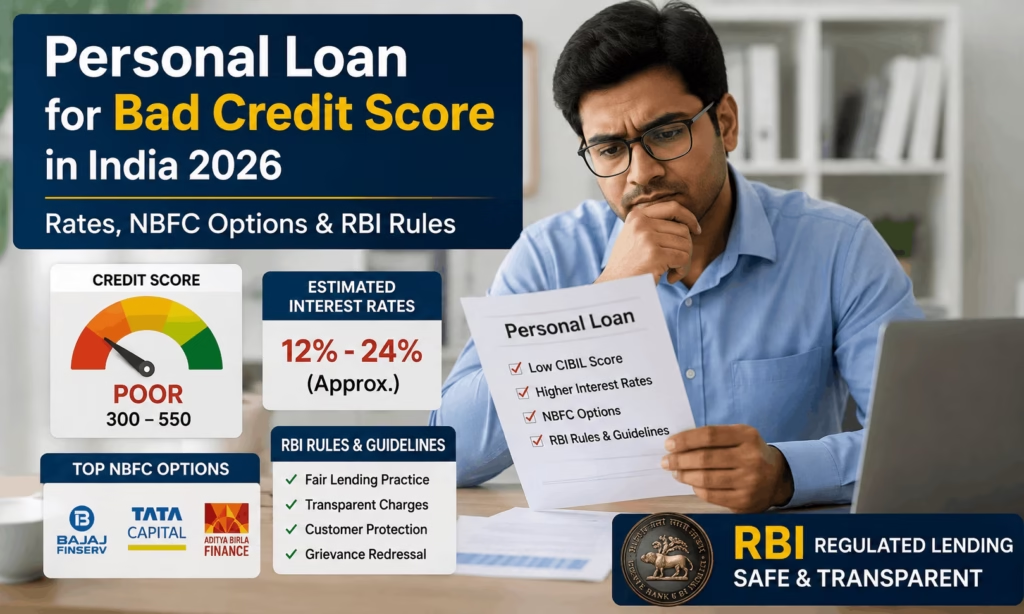
For non-banking financial companies, or NBFCs, rates tend to run higher, reflecting a different risk and regulatory framework. Bajaj Finance has been quoted around 11% to 13%, Tata Capital around 10.99%, and Axis Finance around 12% to 14%. Digital-first lending apps such as KreditBee, Fibe, and Finnable, which primarily serve smaller loan amounts and thinner credit files, have quoted considerably higher ranges, commonly between 14% and 24%, and in some cases higher still depending on the specific lender and borrower risk profile.
It’s worth being clear about what these numbers actually mean: every rate listed above is an advertised starting rate available only to the most creditworthy applicants. Your own actual rate will depend on your credit score, income, employment type, and the specific bank’s internal risk assessment, and it is common for the rate you are actually offered to sit well above the headline starting figure advertised.
How Your CIBIL Score Affects Your Rate and Eligibility
Your credit score is one of the single biggest factors determining both whether you qualify for a large personal loan and what interest rate you are offered. As a general pattern across Indian lenders, a CIBIL score of 750 or above is typically considered the threshold for accessing the lowest advertised rates, while every roughly 50-point increase in your score tends to correspond to a meaningfully lower rate offer, all else being equal. Borrowers with scores below 700 often find their loan options narrow considerably, both in terms of available lenders and the interest rates those lenders are willing to offer, and may find NBFCs, which generally have more flexible but more expensive underwriting criteria, more accessible than traditional banks in that situation.
Documents You Will Actually Need to Apply
Contrary to marketing claims promising a large personal loan with zero documentation, every RBI-regulated bank and NBFC is required to complete standard Know Your Customer, or KYC, verification before disbursing any loan, particularly one in the higher range approaching 50 lakh rupees. For salaried applicants, this typically includes PAN card and Aadhaar card for identity and address verification, recent salary slips, usually covering the last three to six months, bank statements showing salary credits over a similar period, and Form 16 or income tax returns for the most recent one to two years. Self-employed applicants generally need to provide business registration or continuity proof, income tax returns typically covering the last two to three years, audited financial statements where applicable, and business bank account statements.
For loan amounts approaching the higher end of the 50 lakh range specifically, lenders commonly ask for additional documentation, including more extensive income verification, existing loan or credit card statements, and sometimes proof of other assets or investments, since the underwriting scrutiny naturally increases alongside the loan size.
How Long Approval Actually Takes
Processing timelines vary meaningfully depending on the lender and how completely your application is documented from the start. Digitally forward banks and NBFCs commonly advertise pre-approved offers to existing customers with a strong banking relationship, which can be disbursed within a day or two once accepted, since the bank already holds verified income and repayment history on file. For new-to-bank applicants, particularly for larger loan amounts, a more typical timeline runs anywhere from two to seven working days, allowing time for document verification, credit checks, and internal approval processes. Claims of truly instant, same-hour approval for a large, unsecured 50 lakh loan to a completely new customer with no prior relationship to the lender should be treated with skepticism, since this kind of underwriting simply is not consistent with how regulated lenders actually assess risk on high-value unsecured credit.
Processing Fees and Other Charges to Factor In
Beyond the headline interest rate, personal loans typically carry a processing fee, commonly up to around 2% of the loan amount plus applicable GST, though some banks cap this fee at a fixed rupee amount regardless of loan size. Prepayment or foreclosure charges may also apply if you repay the loan earlier than its full tenure, though RBI guidelines have progressively limited these charges for floating-rate loans to individual borrowers in recent years. It is worth requesting a complete, itemized breakdown of all applicable fees, including processing fees, documentation charges, and any prepayment penalties, before signing a loan agreement, since the effective cost of a loan can differ meaningfully from the headline interest rate once these charges are factored in.
How to Improve Your Chances of a Lower Rate and Faster Approval
Maintaining a credit score above 750 remains the single most impactful step most borrowers can take, since it directly affects both your rate and your approval odds across nearly every lender. Applying through your existing salary account bank can also improve your odds and speed, since the bank already has visibility into your income and repayment behavior without needing extensive fresh documentation. Keeping your existing debt obligations, including credit card balances and other loan EMIs, well below your income capacity improves your debt-to-income ratio, a factor most lenders weigh heavily when determining both eligibility and rate. Government and public sector employees, along with employees of well-established, financially stable companies, often receive modestly preferential rates compared to employees of smaller or less established employers, reflecting the lender’s assessment of income stability.
Comparing a Bank Loan vs. an NBFC or Digital Lending App
For a loan approaching the 50 lakh range specifically, established banks generally remain the more suitable option compared to smaller NBFCs or digital lending apps, both because banks typically offer meaningfully lower interest rates at this loan size and because the underwriting process for a loan this large naturally requires the kind of thorough documentation and verification that established banks are set up to handle. Digital lending apps and smaller NBFCs tend to be better suited to smaller loan amounts with faster, lighter-touch underwriting, and their interest rates at higher loan amounts are generally not competitive with what a well-qualified borrower could access through a traditional bank.
Recognizing and Avoiding Fraudulent Loan Offers
The Reserve Bank of India has repeatedly warned consumers about fraudulent digital lending apps and unauthorized lenders that advertise instant, no-documentation loans, particularly through unsolicited text messages, social media ads, and unofficial mobile apps outside official app stores. Genuine warning signs include any lender asking for an upfront fee before disbursing the loan, pressure to make a decision immediately without time to review loan terms, requests for excessive personal data or access to your phone’s contacts and photos as a condition of the app, and any lender that cannot be verified on the RBI’s list of registered NBFCs or is not a scheduled bank. Before proceeding with any personal loan offer, particularly one advertised as involving no documentation or guaranteed approval regardless of your financial profile, verify the lender’s registration status directly through RBI’s official resources rather than relying solely on the lender’s own website or app.
Official Resources for Verifying Lenders and Comparing Loans
| Resource | Purpose | Link |
|---|---|---|
| Reserve Bank of India | Verify registered banks and NBFCs | rbi.org.in |
| RBI list of registered NBFCs | Confirm a lender’s regulatory status before applying | rbi.org.in (NBFC list) |
| CIBIL official site | Check your credit score and report | cibil.com |
| SBI personal loan page | Official rates and application | sbi.co.in |
| HDFC Bank personal loan page | Official rates and application | hdfcbank.com |
| ICICI Bank personal loan page | Official rates and application | icicibank.com |
| Axis Bank personal loan page | Official rates and application | axisbank.com |
FAQs
Can I really get a personal loan up to 50 lakh in India?
What is the lowest personal loan interest rate available in 2026?
Is it true that some lenders offer personal loans with zero documentation?
How much does my CIBIL score affect my personal loan rate?
How long does personal loan approval actually take?
Are NBFC personal loan rates higher than bank rates?
What documents do I need for a large personal loan?
How can I verify a lender is legitimate before applying?
Conclusion
Comparing a personal loan up to 50 lakh India offer in 2026 comes down to looking past advertised headline rates and understanding your own actual eligibility, since real interest rates and approval depend heavily on your credit score, income stability, and existing debt obligations rather than any lender’s marketing promises. Major banks currently offer starting rates in the roughly 9% to 11% range for well-qualified borrowers, with NBFCs and digital lenders generally costing more but offering faster, lighter documentation for smaller amounts. Whatever lender you consider, verifying its RBI registration, reviewing the complete fee structure beyond just the interest rate, and being skeptical of any offer promising guaranteed approval with no documentation remain the most reliable ways to borrow safely and avoid predatory or fraudulent lending schemes.